PR professionals per 100,000 inhabitants in Europe: 2025 country ranking
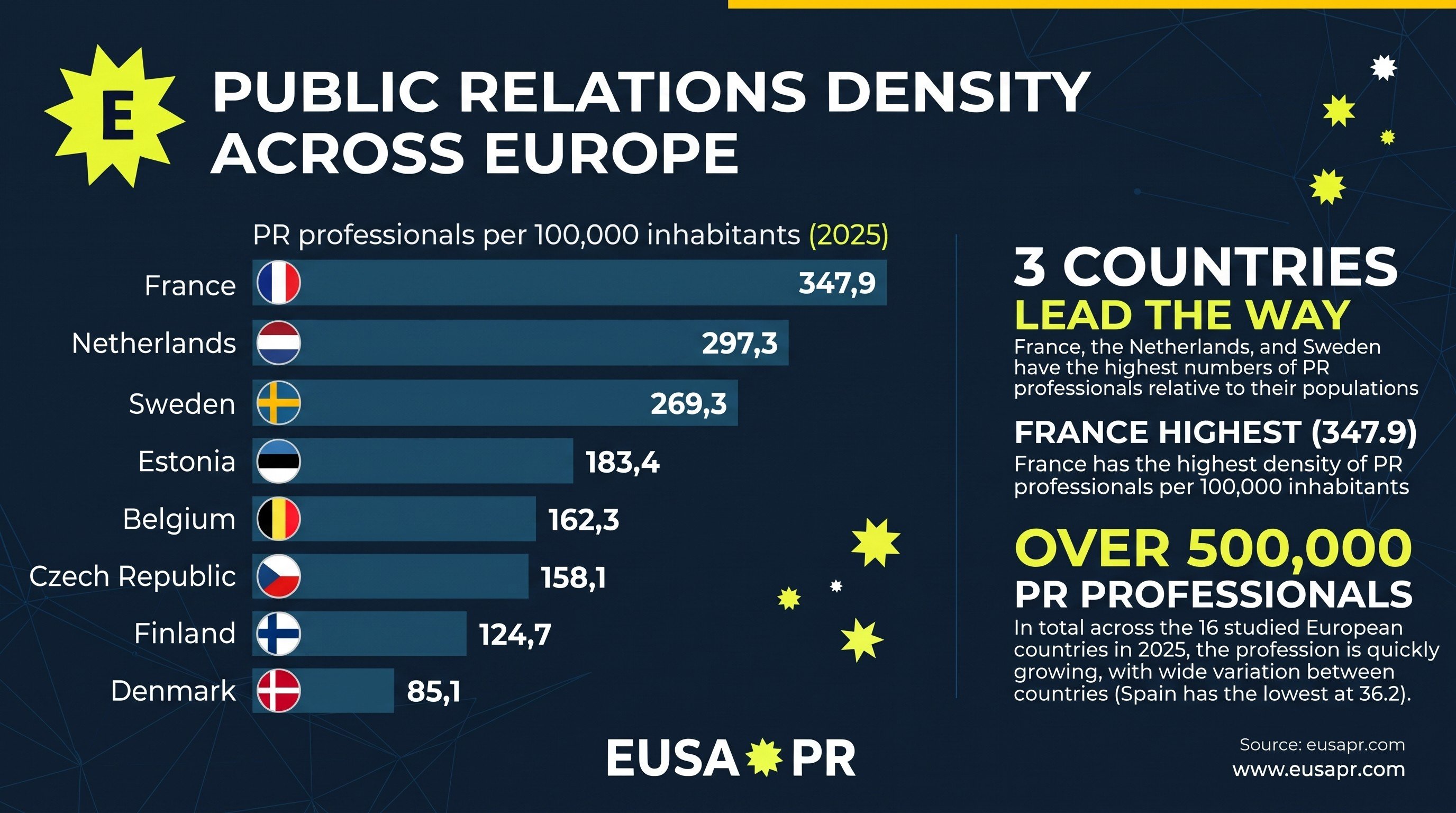
How large is the public relations profession across Europe, and how does it vary between countries? EUSA PR analysed the number of PR professionals in 16 European countries between 2015 and 2025. France, the Netherlands and Sweden have the highest numbers of PR professionals relative to their populations among the countries studied. The profession includes roles such as press officers, PR specialists and PR copywriters.
“PR is becoming increasingly important for organisations, both in the Netherlands and internationally,” says Johan Konst, founder of EUSA PR. “The rise of AI search services is also giving PR a new role. Organisations want to be visible in the answers AI provides. PR can support this by ensuring that organisations and their expertise feature in credible, independent sources.”
Below are the key findings, country-by-country figures and research methodology.
The number of PR professionals relative to population varies widely across Europe. France has the highest density, with 347.9 PR professionals per 100,000 inhabitants, almost ten times the level of Spain at the bottom of the list.
Number of PR professionals in 2025, with PR professionals per 100,000 inhabitants in brackets.
- France: 239,661 (347.9)
- Netherlands: 53,651 (297.3)
- Sweden: 28,512 (269.3)
- Estonia: 2,512 (183.4)
- Belgium: 19,281 (162.3)
- Czech Republic: 17,250 (158.1)
- Finland: 7,028 (124.7)
- Denmark: 5,100 (85.1)
- Romania: 15,110 (79.3)
- Germany: 62,913 (75.3)
- Hungary: 6,818 (71.5)
- Austria: 6,554 (71.3)
- Lithuania: 1,885 (65.2)
- Portugal: 6,869 (60.3)
- Italy: 33,652 (57.1)
- Spain: 17,792 (36.2)
Number of PR professionals in France (2025)
France had 239,661 PR professionals in 2025, compared with 63,947 in 2015. Between 2020 and 2021 the number rose from 94,502 to 165,466. Eurostat flags a break in the French series at that point, so figures before and after 2021 are not fully comparable.
With 347.9 PR professionals per 100,000 inhabitants, France has the highest density in the dataset. That is twice the Belgian level (162.3), more than four times Germany (75.3), six times Italy (57.1) and almost ten times Spain (36.2).
PR professionals in France per year, 2015 to 2025
Number of PR professionals, with PR professionals per 100,000 inhabitants in brackets.
- 2015: 63,947 (96.2)
- 2016: 79,649 (119.5)
- 2017: 76,202 (114.1)
- 2018: 81,040 (120.9)
- 2019: 89,055 (132.3)
- 2020: 94,502 (140.1)
- 2021: 165,466 (244.3)
- 2022: 172,059 (252.7)
- 2023: 194,266 (283.9)
- 2024: 205,497 (299.3)
- 2025: 239,661 (347.9)
Number of PR professionals in the Netherlands (2025)
The Netherlands had 53,651 PR professionals in 2025, up from 30,717 in 2016, an increase of 75%. The number has risen every year since 2016.
With 297.3 PR professionals per 100,000 inhabitants, the Netherlands is second in the dataset after France. That is nearly twice the Belgian level (162.3) and four times the German level (75.3).
PR professionals in the Netherlands per year, 2016 to 2025
Number of PR professionals, with PR professionals per 100,000 inhabitants in brackets.
- 2016: 30,717 (180.9)
- 2017: 32,551 (190.6)
- 2018: 33,871 (197.1)
- 2019: 36,798 (212.9)
- 2020: 39,544 (227.2)
- 2021: 43,389 (248.3)
- 2022: 45,941 (261.2)
- 2023: 49,390 (277.3)
- 2024: 52,815 (294.3)
- 2025: 53,651 (297.3)
Number of PR professionals in Sweden (2025)
Sweden’s PR workforce grew from 18,809 in 2015 to a peak of 34,333 in 2023, then declined to 28,512 in 2025.
With 269.3 PR professionals per 100,000 inhabitants, Sweden is third in the dataset after France and the Netherlands. That is more than twice the Finnish level (124.7) and three times the Danish level (85.1).
PR professionals in Sweden per year, 2015 to 2025
Number of PR professionals, with PR professionals per 100,000 inhabitants in brackets.
- 2015: 18,809 (193.0)
- 2016: 20,847 (211.6)
- 2017: 21,124 (211.3)
- 2018: 19,979 (197.4)
- 2019: 21,149 (206.7)
- 2020: 24,397 (236.2)
- 2021: 26,133 (251.8)
- 2022: 30,462 (291.4)
- 2023: 34,333 (326.3)
- 2024: 30,782 (291.7)
- 2025: 28,512 (269.3)
Number of PR professionals in Estonia (2025)
Data for Estonia is available from 2018, and there is no figure for 2023. In 2025 there were 2,512 PR professionals.
With 183.4 per 100,000 inhabitants, Estonia is above Finland (124.7) and almost three times the level of Lithuania (65.2).
PR professionals in Estonia per year, 2018 to 2025
Number of PR professionals, with PR professionals per 100,000 inhabitants in brackets.
- 2018: 1,316 (99.8)*
- 2019: 1,415 (106.8)*
- 2020: 1,909 (143.7)*
- 2021: 2,742 (206.2)
- 2022: 2,803 (210.5)
- 2023: no data available
- 2024: 2,006 (145.9)*
- 2025: 2,512 (183.4)*
* Statistically unreliable according to Eurostat (small sample).
Number of PR professionals in Belgium (2025)
Belgium had 19,281 PR professionals in 2025. Between 2016 and 2021 the number stayed between roughly 7,100 and 8,100, and in 2025 it rose 63% compared with 2024.
With 162.3 PR professionals per 100,000 inhabitants, Belgium sits between its neighbours. It is about half the level of the Netherlands (297.3) and France (347.9), and twice that of Germany (75.3).
PR professionals in Belgium per year, 2015 to 2025
Number of PR professionals, with PR professionals per 100,000 inhabitants in brackets.
- 2015: 11,132 (99.1)
- 2016: 8,087 (71.5)
- 2017: 8,011 (70.6)
- 2018: 7,259 (63.7)
- 2019: 7,817 (68.2)
- 2020: 7,738 (67.2)
- 2021: 7,148 (61.9)
- 2022: 10,670 (91.8)
- 2023: 13,106 (111.6)
- 2024: 11,822 (100.0)
- 2025: 19,281 (162.3)
Number of PR professionals in the Czech Republic (2025)
From 2015 to 2024 the Czech PR workforce moved between about 8,200 and 12,100 people. In 2025 it rose to 17,250, 47% more than a year earlier.
With 158.1 PR professionals per 100,000 inhabitants, the Czech Republic is about twice the level of Germany (75.3) and Austria (71.3).
PR professionals in the Czech Republic per year, 2015 to 2025
Number of PR professionals, with PR professionals per 100,000 inhabitants in brackets.
- 2015: 9,733 (92.4)
- 2016: 12,057 (114.2)
- 2017: 9,674 (91.4)
- 2018: 9,362 (88.2)
- 2019: 11,294 (106.0)
- 2020: 8,226 (76.9)
- 2021: 9,457 (90.1)
- 2022: 8,613 (81.9)
- 2023: 10,131 (93.6)
- 2024: 11,728 (107.6)
- 2025: 17,250 (158.1)
Number of PR professionals in Finland (2025)
Finland’s PR workforce grew from 5,859 in 2015 to a peak of 9,509 in 2022, then fell back to 7,028 in 2025.
With 124.7 PR professionals per 100,000 inhabitants, Finland is below Estonia (183.4) and less than half the Swedish level (269.3).
PR professionals in Finland per year, 2015 to 2025
Number of PR professionals, with PR professionals per 100,000 inhabitants in brackets.
- 2015: 5,859 (107.1)
- 2016: 6,012 (109.6)
- 2017: 7,369 (133.9)
- 2018: 8,376 (151.9)
- 2019: 8,972 (162.6)
- 2020: 8,917 (161.4)
- 2021: 6,292 (113.7)
- 2022: 9,509 (171.4)
- 2023: 8,708 (156.5)
- 2024: 6,924 (123.6)*
- 2025: 7,028 (124.7)
* Statistically unreliable according to Eurostat (small sample).
Number of PR professionals in Denmark (2025)
Data for Denmark is available from 2021. The PR workforce fell from 7,638 in 2021 to 5,100 in 2025, a decline of 33%.
With 85.1 PR professionals per 100,000 inhabitants, Denmark is close to Germany (75.3) and about a third of the Swedish level (269.3).
PR professionals in Denmark per year, 2021 to 2025
Number of PR professionals, with PR professionals per 100,000 inhabitants in brackets.
- 2021: 7,638 (130.8)
- 2022: 4,899 (83.4)
- 2023: 6,263 (105.6)
- 2024: 5,521 (92.6)
- 2025: 5,100 (85.1)
Number of PR professionals in Romania (2025)
Data for Romania is available from 2017. The PR workforce more than doubled, from 6,913 in 2017 to 15,110 in 2025.
With 79.3 PR professionals per 100,000 inhabitants, Romania is slightly above Hungary (71.5).
PR professionals in Romania per year, 2017 to 2025
Number of PR professionals, with PR professionals per 100,000 inhabitants in brackets.
- 2017: 6,913 (35.2)*
- 2018: 8,934 (45.7)*
- 2019: 10,819 (55.7)*
- 2020: 13,553 (70.1)
- 2021: 8,141 (42.4)*
- 2022: 12,158 (63.8)
- 2023: 14,537 (76.3)
- 2024: 11,822 (62.0)
- 2025: 15,110 (79.3)
* Statistically unreliable according to Eurostat (small sample).
Number of PR professionals in Germany (2025)
Germany had 62,913 PR professionals in 2025, 72% more than in 2015. The dip to 33,335 in 2021 coincides with a methodological break that Eurostat flags in the German data.
With 75.3 PR professionals per 100,000 inhabitants, Germany is close to Austria (71.3) and Denmark (85.1). It is about half the Czech level (158.1) and a quarter of the Dutch level (297.3).
PR professionals in Germany per year, 2015 to 2025
Number of PR professionals, with PR professionals per 100,000 inhabitants in brackets.
- 2015: 36,524 (45.0)
- 2016: 37,750 (45.9)
- 2017: 42,742 (51.8)
- 2018: 45,218 (54.6)
- 2019: 49,505 (59.6)
- 2020: 44,764 (53.8)
- 2021: 33,335 (40.1)
- 2022: 44,418 (53.4)
- 2023: 51,420 (61.9)
- 2024: 46,702 (56.0)
- 2025: 62,913 (75.3)
Number of PR professionals in Hungary (2025)
Hungary had 6,818 PR professionals in 2025, the highest number in the series and 74% more than in 2015. There are no figures for 2022 and 2023.
With 71.5 per 100,000 inhabitants, Hungary is level with Austria (71.3) and slightly below Romania (79.3).
PR professionals in Hungary per year, 2015 to 2025
Number of PR professionals, with PR professionals per 100,000 inhabitants in brackets.
- 2015: 3,924 (40.0)*
- 2016: 2,670 (27.3)*
- 2017: 3,818 (39.2)*
- 2018: 4,032 (41.5)*
- 2019: 3,954 (40.8)*
- 2020: 6,073 (62.7)
- 2021: 4,502 (46.6)*
- 2022: no data available
- 2023: no data available
- 2024: 5,532 (57.7)
- 2025: 6,818 (71.5)
* Statistically unreliable according to Eurostat (small sample).
Number of PR professionals in Austria (2025)
Austria’s PR workforce has been stable for a decade, mostly between 6,000 and 7,300 people. In 2025 there were 6,554 PR professionals.
With 71.3 per 100,000 inhabitants, Austria is level with Germany (75.3) and Hungary (71.5), slightly above Italy (57.1) and about half the Czech level (158.1).
PR professionals in Austria per year, 2015 to 2025
Number of PR professionals, with PR professionals per 100,000 inhabitants in brackets.
- 2015: 6,017 (70.1)
- 2016: 6,411 (73.7)
- 2017: 6,432 (73.3)
- 2018: 4,676 (53.0)*
- 2019: 6,148 (69.4)
- 2020: 6,459 (72.6)
- 2021: 6,430 (72.0)
- 2022: 5,701 (63.5)*
- 2023: 7,262 (79.8)
- 2024: 7,183 (78.4)
- 2025: 6,554 (71.3)
* Statistically unreliable according to Eurostat (small sample).
Number of PR professionals in Lithuania (2025)
Data for Lithuania is available from 2016. The PR workforce has moved between roughly 1,300 and 2,100 people. In 2025 there were 1,885 PR professionals.
With 65.2 per 100,000 inhabitants, Lithuania is about a third of the Estonian level (183.4).
PR professionals in Lithuania per year, 2016 to 2025
Number of PR professionals, with PR professionals per 100,000 inhabitants in brackets. All figures are statistically unreliable according to Eurostat (small sample).
- 2016: 1,351 (46.7)
- 2017: 1,647 (57.6)
- 2018: 1,277 (45.2)
- 2019: 1,739 (61.8)
- 2020: 1,759 (62.6)
- 2021: 1,471 (52.3)
- 2022: 2,073 (73.9)
- 2023: 1,703 (59.6)
- 2024: 1,278 (44.3)
- 2025: 1,885 (65.2)
Number of PR professionals in Portugal (2025)
Data for Portugal is available from 2021. The PR workforce fell from 8,364 in 2021 to 5,778 in 2024 and recovered to 6,869 in 2025.
With 60.3 per 100,000 inhabitants, Portugal is well above its only neighbour Spain (36.2).
PR professionals in Portugal per year, 2021 to 2025
Number of PR professionals, with PR professionals per 100,000 inhabitants in brackets. All figures are statistically unreliable according to Eurostat (small sample).
- 2021: 8,364 (80.5)
- 2022: 6,868 (64.8)
- 2023: 5,997 (54.9)
- 2024: 5,778 (51.6)
- 2025: 6,869 (60.3)
Number of PR professionals in Italy (2025)
Data for Italy is available from 2017. After a low of 19,405 in 2021, the PR workforce grew to 33,652 in 2025, the highest figure in the series.
With 57.1 PR professionals per 100,000 inhabitants, Italy is slightly below Austria (71.3) and about a sixth of the French level (347.9).
PR professionals in Italy per year, 2017 to 2025
Number of PR professionals, with PR professionals per 100,000 inhabitants in brackets.
- 2017: 25,066 (41.7)
- 2018: 31,540 (52.6)
- 2019: 32,742 (54.7)
- 2020: 29,835 (50.0)
- 2021: 19,405 (32.8)
- 2022: 24,400 (41.3)
- 2023: 26,003 (44.1)
- 2024: 30,220 (51.2)
- 2025: 33,652 (57.1)
Number of PR professionals in Spain (2025)
Data for Spain is available from 2021. Spain had 17,792 PR professionals in 2025, 39% more than in 2024.
With 36.2 per 100,000 inhabitants, Spain has the lowest density in the dataset. Portugal (60.3) is well above it, and France (347.9) is almost ten times higher.
PR professionals in Spain per year, 2021 to 2025
Number of PR professionals, with PR professionals per 100,000 inhabitants in brackets.
- 2021: 12,118 (25.6)
- 2022: 10,700 (22.5)
- 2023: 8,895 (18.5)
- 2024: 12,764 (26.3)
- 2025: 17,792 (36.2)
About the research: PR professionals in Europe, an EUSA PR analysis of Eurostat data
This overview was compiled by EUSA PR, an Amsterdam-based agency for public relations across Europe and the U.S.A. EUSA PR requested the underlying figures directly from Eurostat, the statistical office of the European Union, and calculated the country comparisons and population-based figures.
Data and method
- PR professionals: the figures come from the Eurostat Labour Force Survey (EU-LFS), supplied by Eurostat Media Support in April 2026 (dataset R25737). They are annual averages of quarterly data. PR professionals are people whose main occupation falls under ISCO-08 code 2432, “Public relations professionals”.
- Population: the number of inhabitants per country is Eurostat’s population on 1 January of each year (table tps00001).
- Per 100,000 inhabitants: the number of PR professionals divided by the population, multiplied by 100,000. This makes countries of different sizes comparable.
- Countries included: the overview covers 16 European countries with a 2025 figure and a usable time series. The period runs from 2015 to 2025, or from the first year with usable data for that country.
What to keep in mind
- The Labour Force Survey is based on a sample, and people report their own main occupation. Where Eurostat considers a figure statistically unreliable because the sample is small, this is marked with an asterisk.
- In some years no figure is available for a country. These years are listed as “no data available”.